sleep-health
Baby Sleep Problems: 8 Common Causes & How To Fix Them
14071720102156.png&w=64&q=75)


Published: 20 Jan 2026
Updated: 10 Mar 2026
Finding it difficult to put your baby to sleep and don’t know how to help them? Read this blog to know about common baby sleep problems and tips to improve your baby’s sleep pattern.
You can never overestimate the importance of sleep for a baby’s development and well being. Getting enough sleep is crucial for their growth, yet many parents face sleepless nights during their baby’s first year, especially after 4 months of age.
There are several different factors that can affect your baby’s sleep. For the first 3 months, babies cannot differentiate between day and night. As they grow, they start developing a sleep pattern. Studies suggest that “Longer sleep duration in infancy supports cognitive and affective functioning”[1]
Before we go any further, let us try to understand how many hours of sleep does your baby actually need.
How Much Sleep Does Your Baby Need?
The amount of sleep your baby needs depends primarily on their age.
The Indian Academy of Paediatrics (IAP) recommends 14 to 17 hours of sleep in a 24-hour period, for 0-3 month old babies and 12 to 15 hours of sleep per day, for 4-11 month old babies.[2]
Also Read:
Baby Sleep Problems: Signs Parents Shouldn't Ignore
Baby sleep problems may manifest in different ways and it is important that you recognize and address these at the earliest. The most common are:
-
Night waking: This is one of the most common sleep issues faced by parents in the 1st year. It typically means that your baby wakes up frequently at night. Unlike adults, babies do not have a regular sleep cycle.
Newborns tend to sleep in shorter cycles and tend to wake up every now and then for feeding. As they grow, their sleep pattern starts becoming more structured and with longer sleep windows at night. Most babies ideally start sleeping through the night between 6 to 12 months. It can happen earlier too.
0 to 3 month old babies usually wake up every 2 to 4 hours for feeding. 4 to 6 months olds may wake up once or twice. 6 to 8 month olds tend to wake up once while 8 to 1 months old babies can sleep through the night without much trouble.
“Frequent awakenings and long awakenings during nighttime sleep do not lead to the balanced mental and physical development of children, and the habit of breastfeeding every time a child wakes up at night may actually lead to the disruption of nighttime sleep continuity and disrupt the rhythm of the biological clock”[3]
-
Difficulty falling asleep: Some parents may find it difficult to put their babies to sleep as they struggle to fall asleep or may resist it altogether. This usually happens if the baby is overtired or overstimulated. An irregular sleep schedule can also be a contributing factor.
According to the NHS, inability to fall asleep can also be triggered by certain external factors like noise, light, or changes in routine.[4]
Some babies may initially fall asleep while being rocked, held, or fed and as time passes by they start to develop some sort of dependence on these sleep cues and hence are not able to soothe themselves to sleep without these.
A study on Sleep Patterns and Practices in Healthy Indian Infants showed that 45.6% infants were dependent on feeding and 31.6% on rocking to sleep. Only 7.6% did not use any sleep associations and self-soothe on their own.[5]
This dependence can result in frequent waking or increased need for parental intervention to help the baby fall asleep again.
8 Common Causes of Baby Sleep Problems & How To Fix Them
“Supporting sleep during periods of rapid brain development and intervening in case of sleep problems may have long-term benefits for cognitive function and mental health.”[1] There are several reasons why your baby is not able to sleep properly at night.
We have listed the most common of these along with some effective fixes.
Hunger Surge or Growth Spurts:
Your baby has a tiny stomach and needs to be fed frequently to support their growth and well being, especially in the first couple of months. Your little one is quite likely to wake up frequently at night for the first few months to feed. So, if your newborn is waking up frequently at night, it is most likely because they are hungry.
During growth spurt, when your baby is gaining weight and height rapidly, they may feel hungry again and again because their tiny bodies are using a lot of energy. This is common around 2–3 weeks, 6 weeks, and around 3 months.
How to help:
-
Make sure you feed your baby well before bedtime. Don’t stop feeding them unless they let go but at the same time, make sure you are not overfeeding.
-
Make sure you follow a consistent daytime feeding schedule. Prioritize feeding your baby whenever they are hungry.
-
Look out for hunger cues like sucking motions, rooting, or fussiness and feed your little one as you notice these.
Overtiredness
The more tired you are, the more easily you fall asleep. But, it’s not like that for your baby. As surprising as it may seem, an overtired baby is more likely to be fussy at bed time and have trouble falling asleep, as compared to a baby who slept well during the day.
Wondering why this happens?
Well, the science behind it is simple. Prolonged wakefulness can trigger the excess production of stress hormones like cortisol and adrenaline in your little one’s body and this can in turn make them fussy and hard to settle. Overtired babies struggle to fall asleep and even if they do, they wake up frequently.
The most important thing that you need to do is watch out for the cues of overtiredness. These include crying or fussiness around bedtime, frequently rubbing eyes/face and not falling asleep despite all your efforts.
How to help:
-
Give your little one a gentle massage using coconut or almond oil. This will help them to calm down and relax
-
Sing them a lullaby. This is the golden way of calming down your little one. Try to do it without holding or rocking them.
-
As soon as your baby shows any sign of tiredness, put them in bed and set the environment right. You can also try swaddling them
Sleep Regression
Sleep regression is a temporary phase when a baby’s sleep schedule is severely disrupted. It is very common and is most likely to happen when your baby is around 4 months old and then again around 6, 8, 12, 18 and 24 months.
It is triggered by rapid development, usually when your baby is hitting major milestones like sitting up,walking and crawling. Other factors that can cause sleep regression in babies include separation anxiety, moving to a new place, getting a sibling etc.
During a regression, babies may wake more often, resist naps, or take longer to settle.
How to help:
-
Start by establishing a proper sleep routine for your little one as well as yourself.
-
Try not to build a new sleep association and allow the baby to fall asleep in the bed.
-
Try to keep the baby engaged in the waking hours.
Related Reads:
Teething Pain
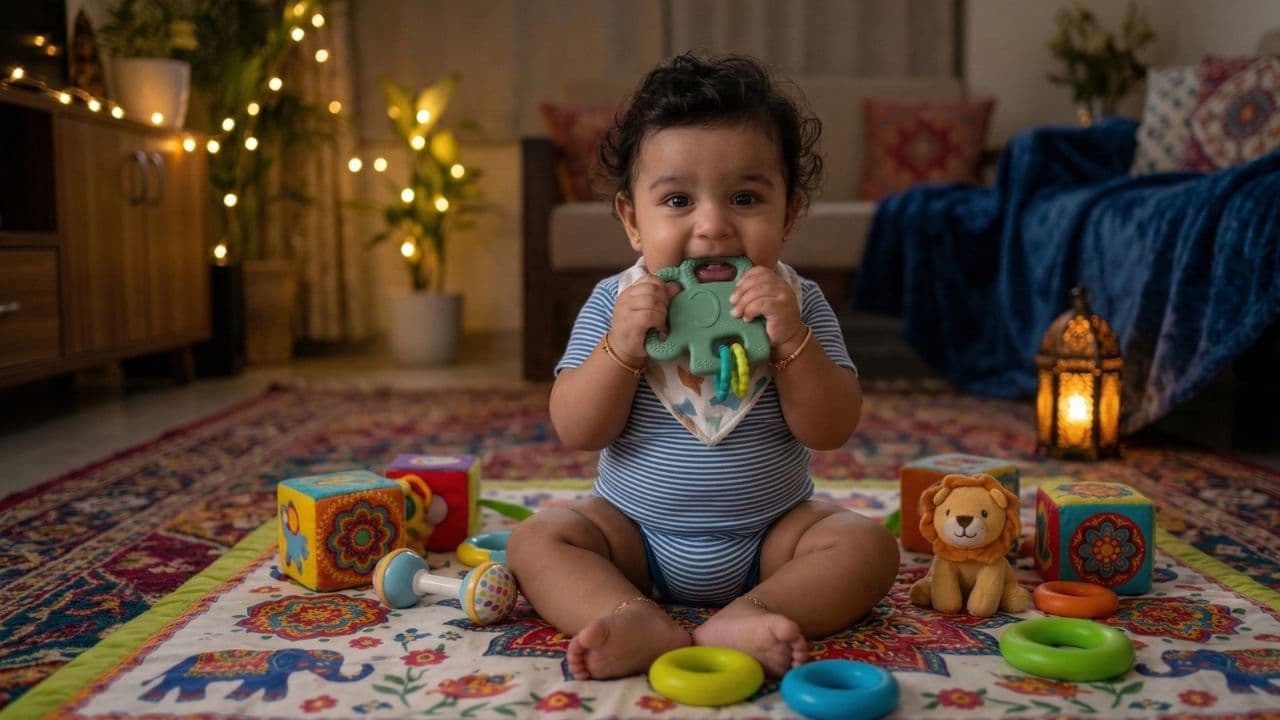
Teething is also a common cause of sleep disruption in babies. It usually starts around six months of age, but, in some babies can happen earlier.
As the new teeth break through the gums, they can cause discomfort leading to irritability, and disrupted sleep. The discomfort is more intense at night.
Watch out for signs like increased fussiness (especially in the evening), increased drooling, chewing on random objects, rubbing mouth or face, mild rise in body temperature and face rash.
How to help:
-
Get your little one a good teether.
-
Gently massage your little one’s gums by rubbing them with a clean finger. For babies older than one, you can use ice wrapper in a cloth or chilled fruits.
-
Do not give any medicine without consulting your doctor.
Separation Anxiety
Babies start experiencing separation anxiety around 6–9 months of age. It is a normal part of development and can often lead to sleep disruption. This happens when babies start to understand object permanence, i.e. they start to understand that objects/people continue to exist even when they are out of their sight.
While this discovery is phenomenal, it can be a little challenging for the babies to fall asleep alone or when put down in their cot.
Separation anxiety can lead to increased crying and fussiness along with difficulty in falling asleep without the parents/caregivers around.
How to help:
-
You need to establish a consistent calming bedtime routine for your baby. You can try a bedtime shower or massage.
-
Practice peek-a-boo as the game helps babies understand that people come back after disappearing.
-
Practice during daytime. Try being apart for short spans of time during the day and return to them with love and affection.
Wet or Dirty Diapers
One of the possible reasons why your baby is not able to sleep at night is wet diapers as these can prevent your little one from settling comfortably. Even slightly wet diapers can cause skin irritation and rashes which can make your little one cranky.
Wet diapers need to be changed frequently, but this again may disturb baby’s sleep, leading to crankiness and sleep problems.
How to help:
-
Change your baby’s diaper right before putting them to sleep. Make sure you do it very gently and without making unnecessary sounds.
-
Switch to overnight diapers that come with higher absorbency
-
During nighttime awakenings, change the diaper only if needed and make sure you do it in dim light. Do not overstimulate your baby in the process.
Uncomfortable Sleep Environment
When the sleep environment is not optimal, babies can experience fragmented sleep due to frequent wake-ups and fussiness. A poorly regulated sleep environment is characterized by too much noise, high/low room temperature, bright lights and strong smells. All these can cause irritation, fussiness and distress.
You need to make the room environment suitable for your baby’s sleep by making simple changes.
How to help:
-
Avoid bright lights and keep the room quiet and dim at night.
-
Maintain a room temperature that is ideal for the baby. It should neither be too hot nor too cold.
-
The bedding should be baby safe. Use a firm mattress and avoid pillows, blankets and loose bedding.
You may also like to read
Illness or Digestive Discomfort
Sometimes, sleep problems can also be caused by underlying illness or digestive issues that lead to discomfort and irritation in babies. Some of the most common of these are gas, colic, reflux and constipation.
These can make it difficult for the baby to fall or stay asleep. Watch out for signs like persistent crying despite you trying to soothe or pacify them, fever, congestion, high body temperature and refusing to feed.
How to help:
-
If your baby’s stomach seems stiff, try using a tummy roll-on to relieve the pain.
-
Inform your paediatrician and get your little one assessed. Do not give any medicine without prescription.
Getting proper sleep is not only crucial for adults but for babies too. Sleep problems in babies should be addressed promptly to ensure their healthy development. Watch out for any unusual signs and consult a paediatrician if the problem persists.
You can connect with our expert doctors at Ask Doctors.
Your All-In-One Baby Toolkit
Monitor milestones, growth, and discover unique baby names easily




Frequently Asked Questions
Be the first to support
Be the first to share