social-&-emotional
Exclusive: Masaba Gupta On Slowing Down, Showing Up & Life After Matara
All age group
397.1K views
14071720102156.png&w=64&q=75)

The blog has been featured by parentune
Published: 22 Apr 2026
Updated: 23 Apr 2026
There’s a certain honesty in the way Masaba Gupta speaks about motherhood. No over-romanticising, no perfection. Just the real, layered experience of raising a child while still holding on to yourself.
From navigating guilt to redefining success, her journey as a mother to Matara offers something many modern parents quietly relate to.
Life As Matara’s Mom: Exhausting, Powerful, Transformative
Masaba describes motherhood as everything at once. Exhilarating, exhausting, powerful and creative.It is not just about raising a child.
“I think beyond just discovering yourself in this new avatar as a woman, I think it's so much about learning how resilient and powerful children are. They're communicative from day one, and they have this amazing power to just adapt to everything that you teach them.” Masaba shares
Parenting, for her, has meant building routines and discipline, but also unlearning old patterns.
“It's been about setting discipline, setting routines both for myself and for her, but more than anything, I think it's been a great learning journey, a great learning curve for me as a woman, as an entrepreneur.” she adds
What stands out is the shift in perspective. Life situations, priorities, even boundaries start to look different.
“It's been exhausting, but probably the best and most wonderfully exhausting year of my life.” she candidly shares.
Sleep, Routine & Real Adjustments
Contrary to the common narrative, she shares that sleep has not been entirely chaotic. Her daughter adapted well to her routine, and Masaba chose to align her own sleep with her child’s.
Sharing about last night, Masaba reveals “I slept eight hours last night because I was really unwell and I was on heavy antibiotics, so that's when I slept, and I slept well. But Matara is a good kid, she has taken to my routine very well, and she allows us to sleep a lot, so that's quite wonderful, and I sleep exactly when she sleeps.”
A small but telling insight. Parenting is not always about control. Sometimes it is about syncing your life with your child’s rhythm.
The Meaning Behind “Matara”
Names often carry stories, and Matara is no different.
For Masaba, it connects two worlds. One rooted in Indian mythology, inspired by Ma Tara and the energy of the Navami day. The other is linked to African heritage, where the name signifies a princess.
She explains, “Matara actually has two meanings. It is also Ma Tara, which is the name of a group of nine Hindu goddesses, and of course there's also Matara, which in African mythology means ‘princess,’ so I wanted her to have a bit of both my legacies, both my heritages.”
She further admits, “I picked it because I think I kind of knew, secretly, I would always name a baby girl, and thank God I had a baby girl, so I got the opportunity to do it.”
It reflects a conscious decision to raise a child connected to multiple identities, cultures, and legacies.
Ambition Did Not Disappear. It Evolved.
Motherhood did not dilute ambition. It refined it.
Masaba openly shares that she still wants the same things professionally. What changed is the pace and the intent behind her choices. Less validation. More meaning.

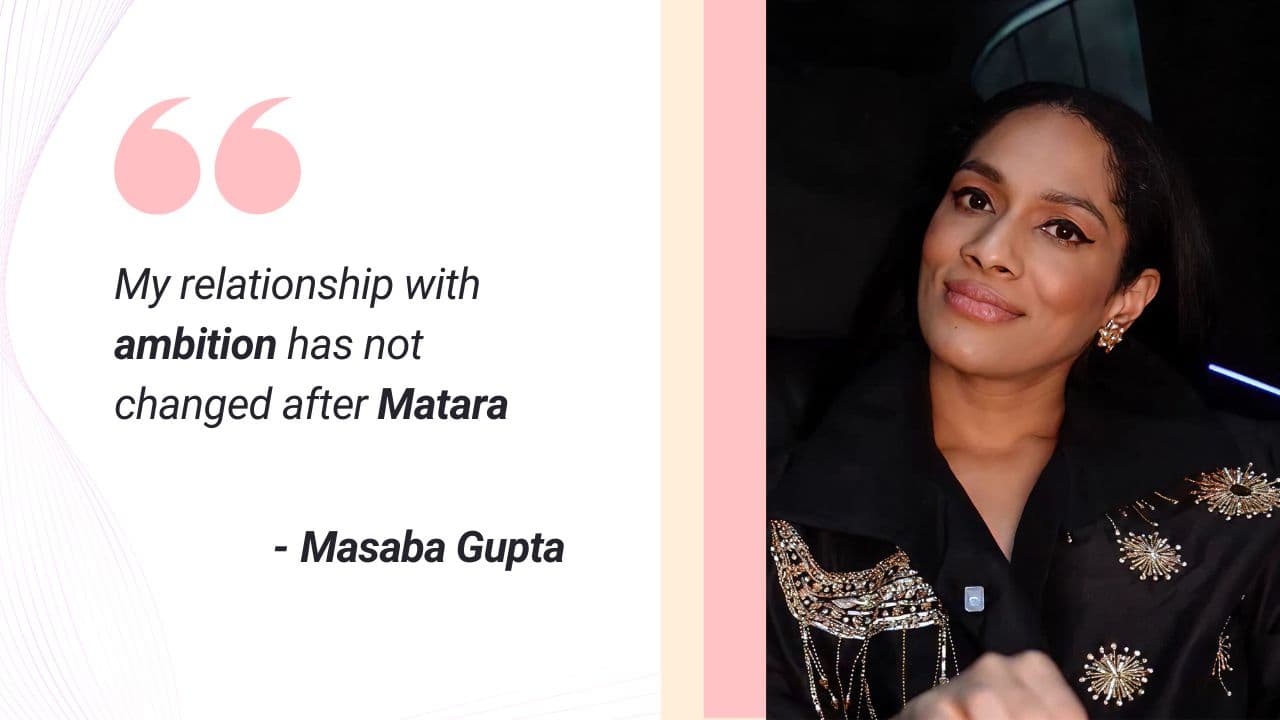
Masaba puts it beautifully, “My relationship with ambition has not changed after Matara. I still want to go out and do the same set of things that I wanted to earlier, but the pace at which I go out and achieve them has changed.”
She goes on to say, “I think I'm no longer in a rush to prove anything. I'm doing fewer things for validation, more things for myself… I've slowed down my pace, but I prioritize things better now. I'm still as ambitious—in fact, I'm even more ambitious now.”
This shift is important. Many parents feel pressured to either slow down completely or “bounce back” instantly. Her experience sits somewhere in between.
Redefining Success
Before becoming a mother, success could look like uninterrupted work or personal achievements.
When asked whether the meaning of success had changed after Matara, Masaba shared, “I don't think so. I think success still has the same meaning because even before I had Matara, and thanks to my mom, I had a very clear definition of what success is. And for me—I don't know if I've ever said this out loud—it means that I'm able to choose where I spend my time, how I spend my time.”
Now, it includes:
-
A walk in the park with her child
-
Choosing how to spend her time
-
Sharing a meal together
She reflects, “I think, for me, family has always been a big part of my definition of success, so yeah, I think it means the same thing. It's just that there's a new member now who I look to for approval a lot more.”
Success, for her, has always included family. Motherhood simply made that definition more visible.
The Reality of Support Systems
Masaba does not present motherhood as a solo journey.
She reveals, “I fall back on my husband a lot. I fall back on my mother a lot when I have to juggle work and home, because I think that it's important to share the load in that way, it's important to share responsibilities.”
Importantly, she also acknowledges something many overlook. Support systems need to be managed with empathy.
Grandparents are aging. Energy levels differ. Expectations need to be realistic.
She went on to say, “I think it's important to have that open mind and not be micromanaging home and work together. For example, I think some days you have to prioritize work and some days you have to prioritize home, so I'm just privileged that I get to pick those days very well.”
It is not just about having help. It is about building a system that works sustainably.
Learning From Her Mother
Her relationship with Neena Gupta plays a significant role in her parenting journey.
Despite generational differences, Masaba leans on her for advice, reassurance, and perspective. What stands out is her acknowledgment of how much mothers sacrifice, something many only fully understand after becoming parents themselves.
She shared, ““I don't know what I would have done in this phase of my life without my own mother, because even though we are different—we have very different approaches and come from different generations—the idea of motherhood when I was born versus today is so, so different.”
She also points out a key difference. Earlier generations relied more on conversations and community. Today, parents rely heavily on information and digital sources, which can sometimes feel overwhelming.
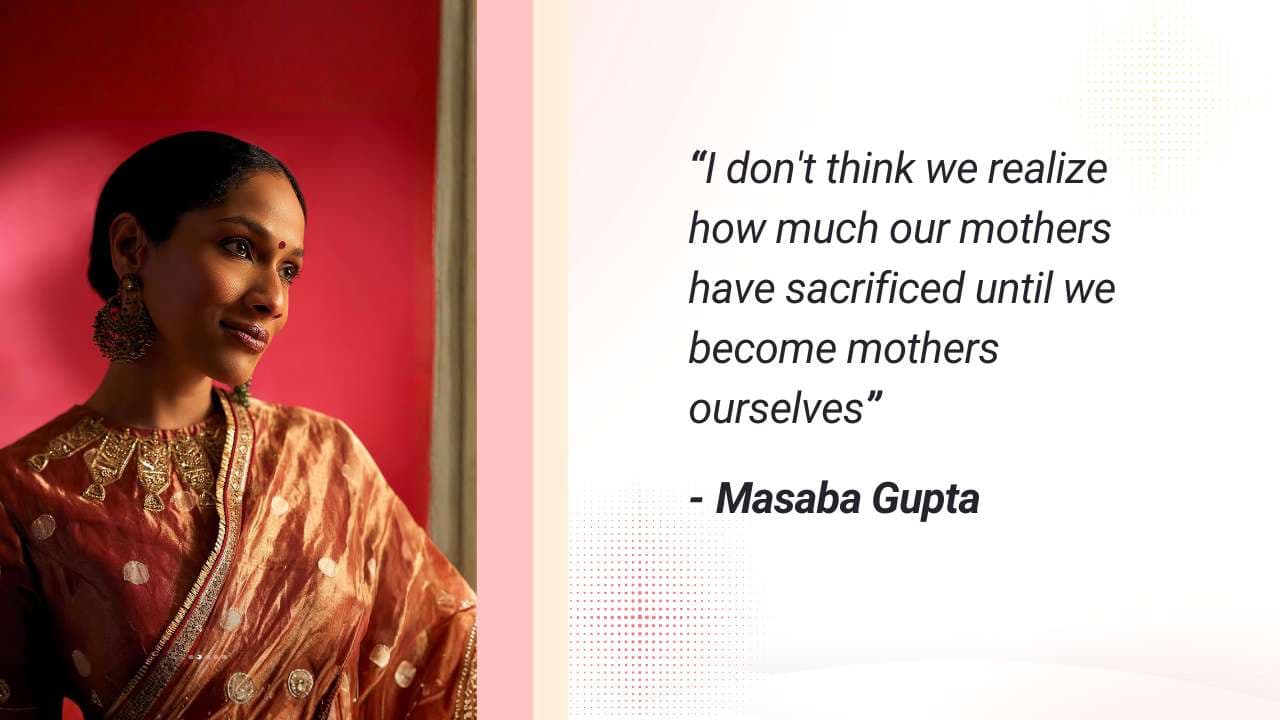
Masaba put it beautifully, “I think respect for our mothers goes up tenfold when we have babies ourselves, and I keep asking her. The one thing that she does tell me is that they didn't have social media—it was a blessing back in the day. So I think they relied a lot on conversation; they actually went up to people's homes, spent time, talked through situations, talked through feelings.”
Postpartum Reality: Not Always Spoken About
Masaba openly talks about postpartum blues.
She admits, “I think I've been very open in my conversation around postpartum blues because I think that not enough people are open about it, and the minute we become candid and honest about our journey is when you empower other women to become candid and honest as well.”
Not anger. Not frustration. But a deep sense of stillness and loss of control. A feeling that life had paused into routines and waiting cycles.
“I think I did not feel frustration or anger. I just felt like my life was over. I felt that this is it, it's just finished, and now I will be in this constant state of ‘what's her wake window and what's not, and what is my feeding hour, and am I eating enough, and am I drinking enough water.’ So I'm not somebody who likes to sit and wait for things to happen, which is why it was very, very tough for me to just sit and wait.” she adds
What helped was time. Around the 7 to 8 month mark, things began to shift.
Her honesty here matters because many parents experience similar emotions but struggle to articulate them.
Practical Parenting: Less Noise, More Clarity
Instead of relying on scattered advice, she chooses to depend on her pediatrician for guidance. Practical, non-alarmist advice helps her stay grounded.
Masaba is clear about this “I track Matara's development and growth by talking to my pediatrician because I believe that he has the information, the tools, and the knowledge to give me the right advice.”
She goes on to say, “I don't like advice that is alarmist in nature, and I think the minute you talk to somebody who's a professional, the alarmist advice that you get goes out of the window. And I think that that's what I need as a mother - yeah, not at all, I think.”
Whether it is developmental tracking or choosing toys, her approach is intentional. Fewer things. More meaningful engagement.
Interestingly, she points out that children often learn the most by observing their parents.
Vaccinations & Decision-Making
Her approach to health decisions is straightforward.
“I think the way that the world is today, it's better to be safe rather than sorry, and we do, of course, ask a lot of questions to the pediatrician about whether this vaccine is absolutely essential or not. But I think post-COVID, the world is a different place, and post-COVID, health has a whole new meaning.”
Do your research to a point. Then trust professionals.
She acknowledges the anxiety around vaccinations but views them as essential, especially in a post-pandemic world. Children recover quickly, and parents often carry more emotional weight than the child does.
Advice For Working Mothers
Masaba shares three grounded takeaways:
-
Guilt will stay. Do not let it control your decisions
-
Build a circle of people who understand your journey
-
Career and motherhood timelines may not align perfectly
She references Indira Nooyi and her idea that the biological clock and career clock often conflict. Something Masaba admits she only fully understood after becoming a mother.
Her perspective is not about sacrifice. It is about delay, not loss.
Interview by Namrata Nongpiur.
Transcribed by Zahirah
Your All-In-One Baby Toolkit
Monitor milestones, growth, and discover unique baby names easily




Be the first to support
Be the first to share