breastfeeding
Colostrum Harvesting In Pregnancy: Meaning, Benefits, Safety, And Storage Explained
14071720102156.png&w=64&q=75)


Published: 12 Aug 2025
Did you know that mothers produce liquid gold for newborns?
No, we are not referring to the gold that you find in jewellery shops, but rather something that is even more valuable for your child’s health and well-being — colostrum, a nutrient-dense immunity booster for newborns produced by the mother’s body towards the end of pregnancy and for the first few days following childbirth.
The concept of colostrum harvesting has become quite popular lately, and you might have even come across celebrities and influencers talking about it. Reading this blog will help you understand what colostrum harvesting means, its benefits, the safety guidelines involved, and how you can store it for your little one.
Colostrum And Its Harvesting
Colostrum is the first form of breastmilk produced by the mother’s body, starting from around the 16th week of pregnancy. Some expecting moms may also notice it leaking from the breasts. It is the same ‘maa ka pehla (first), peela (yellow), ghaada (dense) doodh’ that they talk about in those TV commercials.
Wondering What Makes It So Important For The Baby?
Well, colostrum has a perfect balance of essential nutrients like protein (epidermal growth factor and lactoferrin), vitamin A, magnesium, and minerals, as well as is loaded with antibodies (immunoglobulin A or IgA), White blood cells (Leukocytes), and antioxidants (carotenoids).
Low in volume and high in energy, colostrum is the ideal first food for your baby. This is the reason why it is commonly referred to as liquid gold.
Now, let’s come to Colostrum Harvesting — What Does It Mean?
The term colostrum harvesting refers to the practice of expressing, collecting, and storing colostrum during pregnancy, generally from the 36th week, to ensure there is enough supply for the newborn if needed. It is also known as antenatal expression.
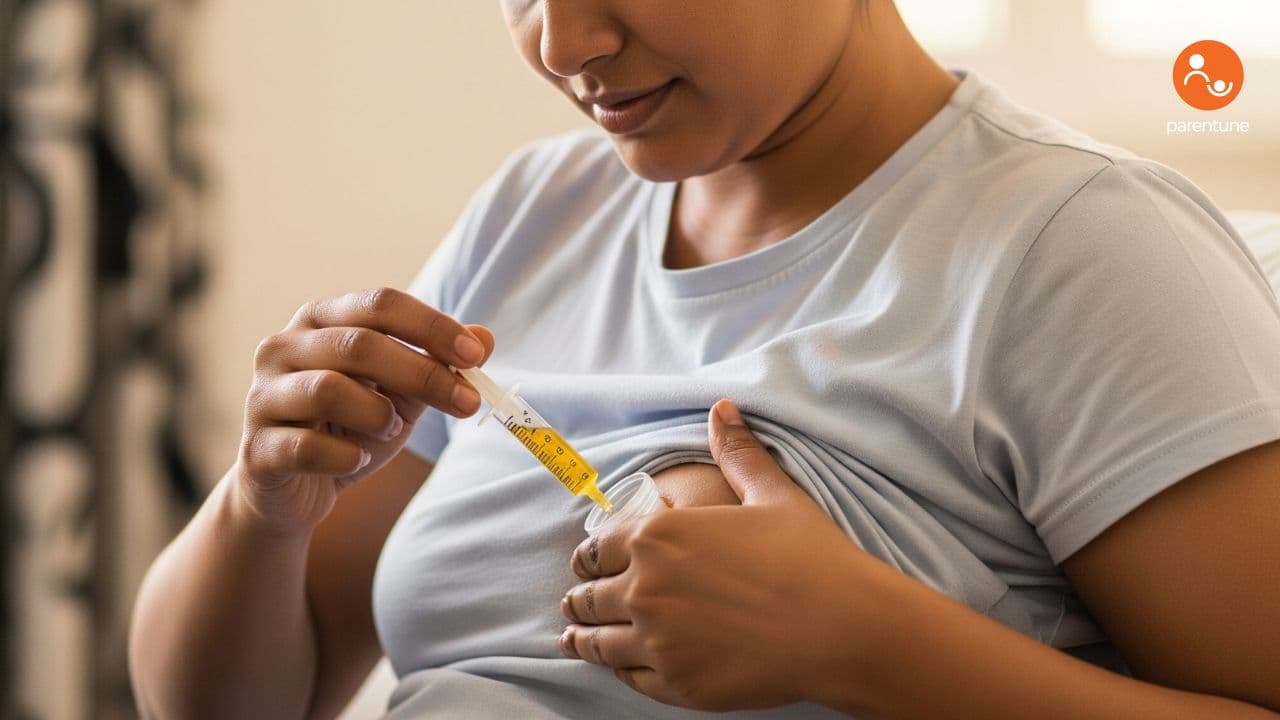
Unlike normal breastmilk expression, which can be done using electric and manual pumps, colostrum harvesting can only be done using your hands.
Benefits Of Colostrum Harvesting During Pregnancy?
Colostrum harvesting is the best way to ensure that the newborn has enough supply of breast milk at the time of birth, regardless of any complications. This is important because colostrum plays a crucial role in
-
Boosting your baby’s immunity - Thanks to the high levels of antibodies and white blood cells that shield the baby from infections.
-
Stabilizing baby’s blood sugar levels - This is extremely important if the mother has diabetes, as in such cases, the baby is at high risk of hypoglycemia post-birth.
-
Supporting babies who need intensive care - This can prove to be really helpful for premature babies or those born with a medical condition, who are kept under observation in the NICU.
-
Ensuring the baby is well fed - In cases where the mother is not able to breastfeed immediately, be it due to c-section, decreased milk production, or latching issues.
Who Can Opt For Colostrum Harvesting?
If you are considering colostrum harvesting, the first and most important thing to do is to ask your doctor or lactation consultant.
It is generally recommended in cases where there are high chances of the mother not being able to feed the baby right after birth. So you may consider harvesting colostrum if
-
You have a history of diabetes or develop gestational diabetes during pregnancy.
-
The milk-producing tissue in your breast is not fully developed. This condition is known as breast hypoplasia.
-
You are taking certain medication to manage hypertension during pregnancy.
-
You have underlying medical conditions like multiple sclerosis or hormonal disorders like PCOS.
-
You have opted for a planned C-section
-
You are carrying more than one baby, i.e., multiple pregnancy.
-
You have a high body mass index, greater than 35.
-
You have had breast surgery in the past.
-
You have faced difficulties with breastfeeding in previous pregnancies.
-
You have a strong history of lactose intolerance or inflammatory bowel disease.
Apart from all these, colostrum harvesting may also be a great option if the baby has been diagnosed with a congenital condition or cleft lip/palate during prenatal checkups.
Is Colostrum Harvesting Safe?
In most pregnancies, the answer is yes; however, despite all the benefits, colostrum harvesting may not be recommended in certain cases. NIH recommends that women should not express colostrum during pregnancy, if
-
It is a high-risk pregnancy.
-
There are high chances of preterm labour.
-
The mother is taking certain drugs that can enter the breast milk and prove to be harmful to the baby.
-
There are medical complications like placenta previa, placenta accreta, placenta percreta, vasa previa, or low-lying placenta.
For women who have already started colostrum harvesting, it is advisable to stop doing it in case they start experiencing contractions or bleeding after expressing colostrum.
Also, it is very important to stick to the safety guidelines and time frame provided by your lactation consultant or doctor.
How Is Colostrum Harvesting Done?
For colostrum harvesting, the milk is to be expressed using your hands. So, a big NO to breast pumps. This requires proper hygiene and technique.
-
Thoroughly wash your hands using soap & water, and then dry using a clean towel. The container in which you’re planning to collect the milk should also be sterile.
-
Get into a comfortable position. Take a deep breath and relax your shoulders. Repeat this a few times.
-
Start massaging your breasts with a warm hand to stimulate milk flow. Start from the outer part and gently move towards the nipple. Make sure you do it from all directions, for at least 2 minutes. Then roll your nipple gently between your thumb & finger, and release it after 1 minute. This step is crucial to stimulate the release of hormones prolactin and oxytocin, which in turn trigger milk production.
-
Now comes the part where you start to express. Position your hand roughly 2 to 3 cm away from your nipple’s base in a C shape. Following a rhythmic motion, firmly compress and release. It should be gentle so that your nipple does not hurt. Make sure your fingers do not slide on your skin or towards your nipple.
-
You should ideally start seeing the colostrum after a few minutes. Collect it carefully in a sterile container or syringe. If you feel the flow is decreasing, change the position of your hand and compress from a different angle. You can express from the other breast if this doesn’t help.
-
The process doesn’t stop here, as a crucial step is left - labeling. Once you have collected enough, label the container and mention your name, hospital contact, EDD, and the date and time of collection.
How to Safely Store Colostrum At Home?
The storage guidelines for colostrum are the same as breastmilk storage post birth. As per The Breastfeeding Network, 2019, “You can store your breastmilk for up to 3 days where you don’t know the temperature, or it runs between 5-10°C”
At 4°C or lower temperature, it can be stored for 5 days; however, if the temperature of the fridge rises above 4°C at any point during this time, it is advisable to either use it within the next 6 hours (not possible in case of harvesting) or else discard it.
The best way to store it is by freezing it at a temperature below -18°C. This will make it possible to preserve the milk for up to 6 months.
Once the milk has been thawed, it cannot be stored again. You should either use it right away or discard it.
How Can You Carry Colostrum To The Hospital?
In order to carry the harvested colostrum to the hospital, you need to arrange a cool bag with ice blocks to maintain a low temperature. Also, let your doctor, caretaker, and assigned nurse know that you have harvested colostrum. If a refrigerator is available, you can store it there for defrosting and use it within 24 hours. At room temperature, it should be used within 5 hours.
Colostrum harvesting is a simple process that comes with a plethora of benefits; however, it is advisable to consult your doctor before you plan to do it.
Your All-In-One Baby Toolkit
Monitor milestones, growth, and discover unique baby names easily




Be the first to support
Be the first to share